


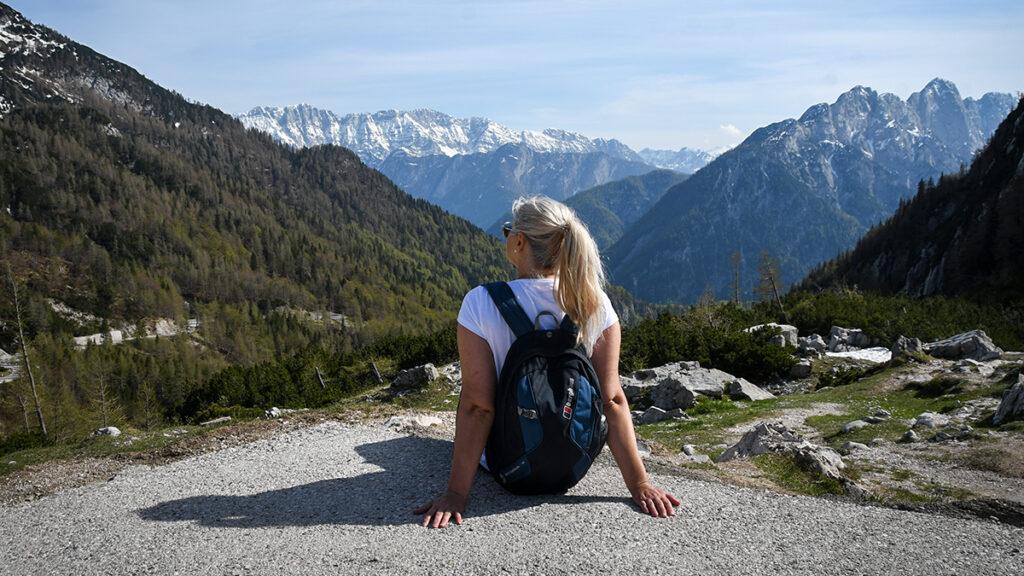
The Alpe Adria Trail Slovenia is a remarkable journey from the high peaks of the Julian Alps to the gentler hills of Friuli in neighbouring Italy. In just one week, hikers experience alpine passes, the turquoise Soča River, waterfalls, historic villages, First World War heritage and the medieval streets of Cividale del Friuli.
Our self-guided Alpe Adria Trail tour follows one of the most varied and scenic sections of this famous long-distance route. It is particularly rewarding in late September and the first days of October, when temperatures are generally more comfortable for longer walking days and the busiest part of the summer season has passed.
What Is the Alpe Adria Trail?
The complete Alpe Adria Trail is a long-distance walking route linking Austria, Slovenia and Italy. It begins beneath Austria’s highest mountain, the Grossglockner, and continues for approximately 750 kilometres through Carinthia, Slovenia and Friuli Venezia Giulia towards the Adriatic.
The full trail is divided into 43 stages, most of which are around 20 kilometres long. Rather than following the entire route, our tour concentrates on a particularly attractive section through western Slovenia and across the border into Italy.
The journey starts in Kranjska Gora and finishes in Cividale del Friuli, covering 128 kilometres over six walking days. It combines genuine alpine scenery with river valleys, forests, waterfalls and historic paths.
This is a substantial trekking holiday with long daily stages, but it does not require climbing equipment or technical mountaineering skills.
Where Does the Trail Go in Slovenia?
The Slovenian section of our tour crosses the Julian Alps, follows the Soča Valley and continues over the Kolovrat Ridge towards Italy.
Despite the relatively short distance, the landscape changes almost every day.
From Kranjska Gora across Vršič Pass
The tour begins in Kranjska Gora, surrounded by the peaks of the western Julian Alps and close to the borders with Austria and Italy.
The first walking stage immediately introduces the most alpine part of the journey. From Kranjska Gora, the path climbs past Lake Jasna and continues towards Vršič, Slovenia’s highest road mountain pass.
Panoramic views open towards the heart of the Julian Alps and Triglav National Park before the trail descends into the Trenta Valley.
This is the most demanding introduction to the tour, with almost 900 metres of ascent and more than 1,000 metres of descent. It also provides some of the journey’s most memorable mountain scenery.
Following the Soča River
The next part of the journey follows the Soča River through Triglav National Park. Famous for its remarkably clear turquoise colour, the river winds between forested slopes, limestone cliffs, narrow gorges and smooth white rocks.
Part of the route follows the official Soča Trail, crossing picturesque wooden footbridges and passing the Small and Great Soča Gorges before reaching the wider valley around Bovec.
Compared with the Vršič stage, the walking is gentler, allowing more time to enjoy the river and surrounding landscape.
The Soča Valley is one of Slovenia’s most distinctive natural regions. The combination of emerald water, white limestone and high mountain peaks creates scenery found nowhere else in the country.
Waterfalls and the Village of Drežnica
From Bovec, the route continues towards two of the valley’s best-known waterfalls.
Virje Waterfall flows into a green pool beneath the Kanin mountains, while the powerful Boka Waterfall drops from a high limestone wall above the valley.
The day ends in Drežnica, a peaceful mountain village situated beneath Mount Krn and high above the Soča Valley. Its location offers a very different atmosphere from the livelier outdoor centre of Bovec.
Walking through History
The landscape between Drežnica and Tolmin is beautiful, but it also carries powerful reminders of the First World War.
The trail joins sections of the Walk of Peace, which connects former military paths, trenches, chapels, fortifications and outdoor museums associated with the Isonzo Front.
These remains have gradually become part of the landscape, creating a walking experience that combines natural beauty with European history. Hikers are not simply passing through the valley; they are also discovering the events that shaped it.
Over the Kolovrat Ridge
After reaching Tolmin, the route climbs towards the Kolovrat Ridge.
This is the biggest climbing day of the tour, but the reward is an extensive view in two directions: back towards the Julian Alps and south across the hills towards the Friulian plain and the Adriatic.
The open-air museum on Kolovrat preserves trenches, observation points and passages from the First World War. Today, the ridge is peaceful, open and panoramic.
The trail then crosses the border into Italy and continues to the small village of Tribil Superiore.
From Alpine Slovenia to Cividale del Friuli
The final walking stage has a noticeably different character. The high mountains are now behind you, and the route passes through chestnut forests, old pastures and quiet Italian villages.
Before descending towards the plains, the trail visits Castelmonte, one of the oldest pilgrimage sites in the region. Its hilltop position offers wide views across Friuli.
The journey finishes in Cividale del Friuli, a historic town known for its medieval streets, stone bridges and Lombard heritage. After several days among mountains, rivers and remote villages, its cafés and lively old centre provide a fitting conclusion to the tour.
Why Hike the Alpe Adria Trail in Early Autumn?
Late September and early October can be an excellent time to walk this section of the Alpe Adria Trail.
Cooler Walking Temperatures
The strongest summer heat has usually passed, making long stages and sustained climbs more comfortable.
This is especially welcome on the climb to Vršič and during the longer stages around Drežnica, Tolmin and Kolovrat. Walking for six or seven hours is usually more pleasant in moderate autumn temperatures than during the hottest weeks of summer.
Quieter Trails and Villages
The main European holiday period is over, so trails, viewpoints and popular places around Kranjska Gora, Bovec and the Soča Valley generally feel quieter.
Accommodation, restaurants and visitor attractions are still operating, but the atmosphere is often more relaxed than in July and August.
For more information about the season, read our guide to autumn hiking in Slovenia.
Autumn Colours and Clear Views
The first autumn colours begin to appear in the forests, particularly around Drežnica, Tolmin, Kolovrat and the Italian border.
Clear autumn days can also provide excellent visibility from Vršič and Kolovrat, with views stretching from the Julian Alps towards the Friulian plain.
The softer light and changing forests make this an especially attractive season for photography.
A Route That Moves towards a Milder Climate
The direction of the journey is another advantage.
The tour begins in the higher Julian Alps before gradually descending towards the lower and generally milder landscapes of Friuli. Alpine valleys give way to forests, rolling hills, vineyards and historic Italian towns.
The scenery, vegetation, architecture and food change noticeably as the journey progresses. This transition from Alpine to Mediterranean Europe is one of the tour’s greatest attractions.
Autumn Weather Still Requires Preparation
Early autumn does not guarantee stable weather.
The Vršič stage reaches genuine alpine terrain, where temperatures can be considerably lower than in the Soča Valley or Italy. Rain, strong winds and even early snow are possible at higher elevations.
Hikers should bring waterproof clothing, warm layers, sturdy footwear and suitable equipment for changing conditions. Starting early is also important, as daylight hours are shorter than in midsummer.
The route is offered only while conditions are normally suitable. Weather and trail safety must always take priority over the planned programme.
A Self-Guided Tour with Luggage Transfers
This tour allows you to walk independently without having to organise every practical detail yourself.
Accommodation is arranged in hotels and locally run guesthouses, while your main luggage is transferred between overnight stops. You carry only the equipment, food and water required during the walking day.
Route information and electronic navigation are provided, together with a welcome meeting and local backup service.
The result is a genuine long-distance walking journey with the comfort of a prepared itinerary, reserved accommodation and luggage waiting at the end of each stage.
Who Is the Alpe Adria Trail Slovenia Tour For?
The tour is best suited to regular and experienced walkers with good general fitness.
It Is a Good Choice for Hikers Who:
- are comfortable walking for five to seven hours on consecutive days;
- enjoy daily distances of approximately 20 to 24 kilometres;
- can manage prolonged climbs and steep descents;
- want to complete a continuous journey rather than a series of separate day walks;
- enjoy a combination of mountains, rivers, history, villages and local culture;
- prefer independent walking with organised accommodation and luggage transfers.
It is particularly rewarding for curious travellers who want to see how the landscape changes from the Julian Alps to the hills and historic towns of Italy.
Who May Find It Too Demanding?
The tour is less suitable for occasional walkers looking for short and easy strolls.
Several stages involve substantial height gain, long descents and changing terrain. Hikers need appropriate footwear, good endurance and confidence on mountain and forest paths.
Anyone uncomfortable with long walking days or repeated climbs should consider one of our easier self-guided hiking tours in Slovenia instead.
For fit and experienced hikers, however, few week-long journeys offer such an impressive variety of landscapes and experiences. From the Julian Alps and emerald Soča River to the forests, villages and historic towns of Italy, the Alpe Adria Trail is a journey that feels much longer than the distance shown on the map.